
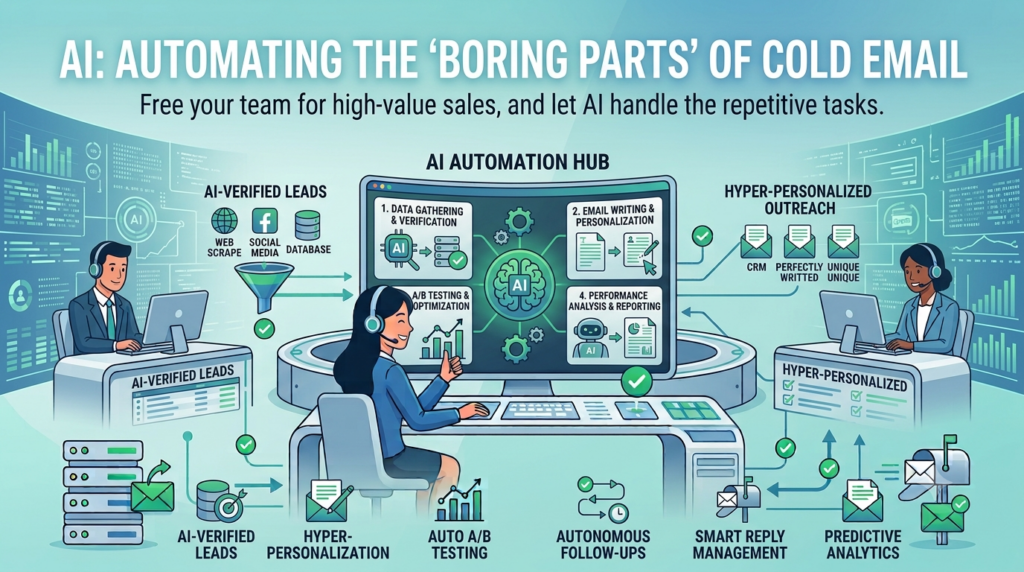
How AI Handles The Boring Parts Of Cold Email is by automating the repetitive technical tasks that keep campaigns running smoothly, allowing you to focus on writing emails, building relationships, and booking meetings.
There is a version of cold email that everyone wants. You write a good email, send it to the right people, get a few replies, and book a few meetings. That is the part of the job that feels like real work.
Then there is the rest of it—DNS records, mailbox warmup, daily sending limits, inbox rotation, list hygiene, bounce rate monitoring, sending schedules that respect time zones, and domain blacklist checks. These aren’t the features highlighted on most cold email platforms, but they are the tasks that determine whether your campaigns succeed or fail.
Understanding How AI Handles The Boring Parts Of Cold Email shows why modern AI assistants are becoming essential for outbound sales. They continuously manage these technical processes behind the scenes, reducing manual effort and helping maintain strong deliverability.
An AI cold email assistant configures, monitors, and optimizes your email infrastructure automatically. The work still gets done—you simply don’t have to spend hours managing it yourself.
This guide explains How AI Handles The Boring Parts Of Cold Email, covering the tasks an AI assistant configures, monitors, and fixes while you focus on the conversations that generate meetings and revenue. By learning How AI Handles The Boring Parts Of Cold Email, you can spend less time on repetitive administration and more time growing your pipeline.
What does the AI handle at setup?
When you sign up for a cold email tool, there is a list of things you have to do before your first campaign can go live. Most people get through about half of the list, do the other half wrong, and figure it out after their first campaign goes to spam.
An assistant walks you through it. You sign up, open the chat panel, and tell it what you want to do. It asks which provider you use (Gmail, Outlook, or a custom domain), takes you to the right place in the product, and walks you through connecting your mailbox.
After the mailbox is connected, the boring part starts. The assistant checks the DNS records on your sending domain (SPF, DKIM, DMARC) and tells you which ones are missing or wrong. If DKIM is set up but DMARC is not, you get a specific instruction with the exact record to add. If SPF is misconfigured, the assistant shows you the fix.
Setting up DNS used to be the step where most people stopped. You hit a wall of acronyms, the help articles are dense, you do not know what your DNS host looks like, and you give up. The assistant walks you through each record on the actual setup you have, not on a generic example that does not match your provider.
How does AI handle warmup?
Warmup is the process where your mailbox slowly increases its sending volume over a few weeks while having natural looking conversations with other warmup accounts. The point is to build sender reputation before you start sending cold outreach.
Most people get warmup wrong in one of three ways. They turn it on and forget about it. They turn it on, increase their sending volume before warmup has built enough reputation, and burn the mailbox. They turn it on, panic at the first sign of a low inbox placement number, and turn it off.
An AI assistant handles the pacing. It enables warmup with sensible defaults based on the age of the mailbox. It increases the ramp slowly. It watches the inbox versus spam ratio in the warmup network and pauses or adjusts if something looks wrong. If you ask it whether you are ready to scale up sending, it looks at your warmup status and tells you yes or no, with a reason.
The default settings work for most people. If you want to be more aggressive (you are a power user, you know what you are doing), you can ask the assistant to push the ramp faster. If you are nervous about deliverability (first time, important domain), you can ask it to keep things slow.
What about sending limits and inbox rotation?
Once you have multiple mailboxes connected, you can rotate sending across them so that no single mailbox is doing all the work. This protects your domain reputation and lets you scale volume without burning out one inbox.
The assistant handles the rotation. When you create a campaign, you pick the mailboxes that send for it, and the assistant distributes the sends across them based on the daily limit for each. If one mailbox has a lower limit because it is newer or has been warming for less time, the assistant respects that. If you add a new mailbox in the middle of a campaign, the assistant includes it in the rotation.
Sending limits are the same. The assistant suggests a starting daily limit based on your mailbox age and warmup status. If you ask it to increase the limit, it tells you whether the mailbox can handle it. If the bounce rate goes up after you increase the limit, the assistant notices and tells you to dial back.
How does AI keep your list healthy?
List hygiene is the part of cold email that nobody enjoys. Bad emails on your list cause bounces. Bounces hurt your sender reputation. Bad sender reputation lands future emails in spam. The hygiene work is what prevents that, but it is dull and easy to put off.
An assistant flags the issues. After a campaign runs, if the bounce rate is high, it tells you which leads bounced and offers to remove them from the list. If a lead’s email looks malformed before you even send (no domain, no at symbol, obviously fake), it can warn you during the upload. If a domain is on a known blacklist, it flags that too.
You can also ask the assistant to filter your list against simple rules, things like “remove anyone without a first name” or “remove anyone whose company is missing”. The hygiene work happens in the same conversation as everything else, not in a separate tool you have to remember to use.
How does AI handle schedule windows?
Schedule windows are the time of day and day of week when your campaigns send. They matter because nobody wants to send a cold email at 3 in the morning local time, and time zones across your lead list make this surprisingly hard to get right.
The assistant picks a sensible default based on the time zone you set on the campaign. If your campaign is targeting US prospects, it picks business hours US time. If you have a mixed list across time zones, it lets you pick whether to send by the recipient’s time zone or by yours.
You can also ask for specific windows. Mornings only, weekdays only, skip Friday afternoons, send during early Tuesday because that is when your replies were highest last month. The assistant configures the schedule and explains what it set up.
What does AI watch in the background?
Once campaigns are running, the assistant watches a few things in real time. Mailbox connection status (so it tells you if your Gmail token expired before you find out from a missed sending day). Bounce rate by campaign (so you know if a list is going bad before it ruins your sender reputation). Reply rate by campaign (so you know which sequences to scale and which to kill). Warmup status (so you know when a mailbox is ready for more volume).
If something goes wrong, the assistant tells you. Not in a generic notification that scrolls past. In a specific message about your specific account, with a specific recommended fix.
You can also ask at any time. “How are my campaigns doing?” pulls a summary. “Why has my reply rate dropped this week?” runs a diagnostic. “Is mailbox four ready to scale up?” checks the warmup data and gives you a yes or a no.
What this means for you?
The customer experience benefit is simple. The work that used to take a day of reading help articles, googling DNS instructions, configuring warmup, picking sending limits, and worrying about whether you did it right, becomes a conversation. You ask, the assistant configures. You ask again, the assistant explains what it did. You ask why something looks off, the assistant tells you.
The boring parts of cold email still get done properly, because they have to. You just do not have to be the one looking up what SPF means at 11pm on a Sunday before launching your campaign on Monday.