
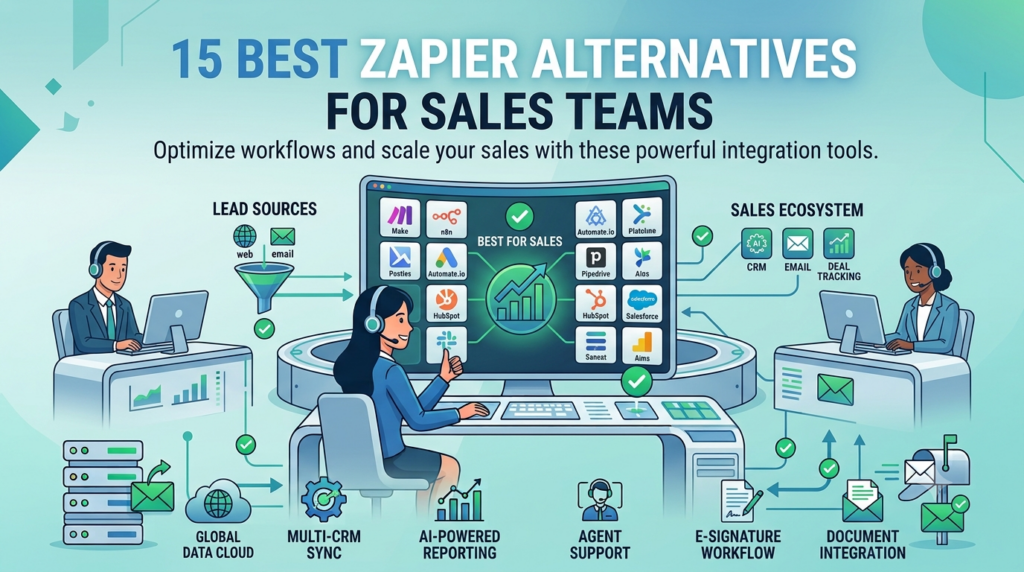
15 Best Zapier Alternatives for Sales Teams help businesses automate workflows more efficiently while reducing costs and eliminating unnecessary manual work.
Zapier works perfectly until it doesn’t. For many sales teams, that breaking point comes when you’re paying hundreds of dollars each month to connect apps that still require manual intervention at critical stages of the sales process.
The 15 Best Zapier Alternatives for Sales Teams in 2026 are more than simple workflow automation tools. They understand sales context, including deal stages, pipeline velocity, lead routing, and multi-touch attribution. Instead of forcing users to build fragile automation chains, these platforms provide smarter workflows that are easier to manage and more reliable over time.
The biggest difference between true Zapier competitors and basic webhook managers is intelligent automation. The best platforms offer native CRM integrations, sales-focused triggers, advanced conditional logic, and automation that continues working even as APIs and business processes evolve.
We tested 23 automation platforms using real-world sales workflows to evaluate reliability, flexibility, pricing, and ease of use. The 15 Best Zapier Alternatives for Sales Teams featured in this guide earned their place by offering better functionality, lower costs, stronger CRM integration, or more dependable automation than Zapier.
Whether you’re scaling outbound sales or streamlining internal operations, these 15 Best Zapier Alternatives for Sales Teams can help your business automate more tasks while allowing your sales representatives to focus on building relationships and closing deals.
Why Zapier Falls Short for Sales Operations
The Surface-Level Connection Problem
Zapier excels at simple data passing: when this happens in App A, do that in App B. For marketing workflows and basic administrative tasks, that’s often enough. For sales operations, it’s painfully inadequate.
G2 reviews from sales users frequently mention ‘limited functionality for complex workflows’ as a primary frustration, especially when trying to build advanced, multi-step automations. One sales ops manager wrote: “We spent three months building Zaps only to discover we couldn’t handle the conditional logic our sales process required. Everything worked in testing, nothing worked with real prospects who don’t follow linear paths.”
Sales workflows require context awareness. If a prospect opens an email, visits the pricing page, but doesn’t book a call, the right next action depends on their industry, deal size, previous engagement history, and current pipeline stage. Zapier sees those as separate, unrelated data points. Sales-focused automation platforms understand they’re all part of a single buyer journey.
The Cost Spiral That Catches Everyone
Zapier’s pricing looks reasonable until you’re actually using it for sales at scale. The free tier caps at 100 tasks monthly, which sounds fine until you realize that every action in a multi-step workflow counts as a task. Updating a CRM record, sending a Slack notification, and logging activity? That’s three tasks for one prospect action.
Sales teams hit the 750-task tier ($20-30/month) within days, then rapidly scale to the 2,000-task tier ($69/month annually or $103.50/month monthly) or higher. One agency we spoke with was paying $599/month for 50,000 tasks, most of which were redundant data syncs that a proper sales automation tool would handle natively.
Analyst firms like Forrester have warned that integration and automation tooling can consume a significant slice of martech budgets yet deliver limited measurable value when those tools aren’t purpose-built for the use case. Translation: you’re overpaying for tools that don’t actually solve your problem.
When Zaps Break, Sales Stop
Here’s the scenario every sales ops person dreads: a critical Zap stops working, but you don’t notice until three days later when your VP asks why 47 hot leads from the trade show haven’t been contacted. The Zap failed because Salesforce changed its API structure slightly. Zapier’s error notification went to an inbox nobody checks. Prospects went cold.
User reviews on sites like G2 and Capterra often mention that when Zaps fail, the errors can be hard to detect or debug, which is risky when workflows are routing hot leads.
Sales-specific automation platforms build in redundancy, error handling, and monitoring precisely because they understand that automation failures in sales don’t just create inconvenience. They directly impact revenue.
The 15 Best Zapier Alternatives for Sales Teams
1. SmartAgent: Multi-Agent Orchestration That Actually Understands Sales
While every other platform on this list moves data between apps, SmartAgent operates at a fundamentally different level. Instead of connecting tools, it deploys AI agents that understand sales context and orchestrate complex workflows through natural language instructions.
Tell SmartAgent: “When a prospect visits our pricing page three times but doesn’t book a demo, have one agent research their recent LinkedIn activity, another agent analyze their company’s tech stack, then generate a personalized follow-up sequence that references both. If they engage via LinkedIn but ignore email, switch the primary channel and adjust messaging accordingly.”
That level of orchestration would require 30+ Zaps, multiple external tools, and constant manual oversight. With SmartAgent, it’s a single instruction to an agent that continuously monitors, adapts, and executes.
The multi-agent architecture means different specialized agents handle different aspects of your sales workflow. The prospecting agent identifies and researches leads. The engagement agent manages multi-channel outreach. The intelligence agent monitors signals and adjusts strategy. They work together without requiring you to manually connect each piece.
Key Features:
- Natural language workflow creation (no visual builders or code required)
- Multi-agent system with specialized agents for prospecting, engagement, and intelligence
- Context-aware decision making based on prospect behavior across channels
- Automatic channel switching based on engagement patterns
- Native integration with Smartlead’s email infrastructure and SmartProspect database
- Real-time adaptation to prospect signals without manual intervention
- Multi-channel orchestration (email, LinkedIn, phone) in unified sequences
- Built-in deliverability intelligence to optimize sending patterns
Best for: Sales teams that need intelligent orchestration across prospecting, engagement, and pipeline management rather than simple app connections.
2. Make (formerly Integromat): Visual Logic for Complex Sales Workflows
Make takes Zapier’s linear approach and adds the branching logic and conditional paths that sales workflows actually require. The visual builder shows you exactly how data flows, where decisions happen, and what executes under different conditions.
Capterra reviews praise the flexibility: “Make handles our complex lead qualification logic that Zapier couldn’t touch. We route leads differently based on 12 different criteria, and Make makes it actually manageable.” The learning curve is steeper than Zapier’s, but the capability ceiling is exponentially higher.
The platform excels at scenarios like: lead comes in from webinar, check if they’re in your CRM, if yes update their record and notify their assigned rep, if no check company size against ICP criteria, if match create record and assign to territories based on geography and industry, if no match send to nurture campaign. That’s a single Make scenario. In Zapier, it’s multiple Zaps with high failure potential.
Key Features:
- Visual workflow builder with drag-and-drop scenario creation
- Advanced router and filter modules for complex conditional logic
- Iterators for processing arrays and batch operations
- Error handlers and fallback routes for reliability
- Data transformation functions without custom code
- Scheduling and webhook triggers with millisecond precision
- 1,500+ apps and services integration library
- Execution history with detailed logs for debugging
- Template marketplace with pre-built sales scenarios
Best for: Sales ops teams comfortable with visual workflow builders who need sophisticated routing and conditional logic.
Pricing: Free tier available; paid plans from $9/ 9/month.
3. Workato: Enterprise-Grade Sales Automation with Recipe Intelligence
Workato positions itself as the enterprise alternative, and the platform delivers for sales organizations with complex tech stacks and compliance requirements. The “recipe” system includes pre-built automation templates specifically for Salesforce, HubSpot, and other sales tools that understand common sales workflows.
What sets Workato apart is the ability to handle batch operations and schedule complex syncs. Need to update 10,000 CRM records nightly based on engagement data from six different sources? Workato processes that without rate-limiting issues that would break Zapier.
G2 reviews from enterprise users highlight reliability: “Three years running Workato for our global sales org. Zero failures, handles our complexity, and scales with volume.” The trade-off is cost. Workato’s enterprise pricing starts at $10,000+ annually.
Key Features:
- Pre-built recipe templates for Salesforce, HubSpot, and 1,200+ apps
- Enterprise-grade connectors with OAuth 2.0 and custom authentication
- Batch processing for high-volume data operations
- Recipe lifecycle management with version control and testing environments
- Real-time and scheduled trigger options with backlog processing
- Data masking and encryption for compliance (GDPR, SOC 2, HIPAA)
- Workbot for Slack and Teams integration with conversational automation
- API management and custom connector building
- Dedicated support with SLAs and implementation services
Best for: Enterprise sales organizations with complex tech stacks, high data volumes, and a budget for sophisticated automation.
Pricing: Contact for custom quote; enterprise-focused pricing.
4. n8n: Open-Source Flexibility Without Vendor Lock-In
n8n offers the rare combination of Zapier-style ease and complete customization through its open-source model. Sales teams can self-host, modify workflows at the code level when necessary, and avoid per-task pricing entirely.
The platform includes 400+ integrations with robust error handling and the ability to write custom functions in JavaScript when pre-built nodes don’t cover your needs. For sales teams with technical resources, n8n provides maximum control.
Users on Capterra note: “We run n8n on our own infrastructure. No task limits, no vendor pricing games, and we can customize anything.” Another: “Finally, automation that doesn’t treat us like children who can’t handle complexity.”
Key Features:
- Self-hosted deployment option for complete data control
- Visual workflow editor with node-based design
- 400+ native integrations, including all major CRMs
- Custom JavaScript functions for advanced data transformation
- HTTP request node for connecting to any API
- Credential system with encryption and team sharing
- Workflow versioning and rollback capabilities
- Webhook triggers and cron-based scheduling
- Expression editor for dynamic data manipulation
- Community-built nodes and workflow templates
- Docker and Kubernetes deployment support
Best for: Technical sales teams or those with development resources who want customization and cost control.
Pricing: Free self-hosted; cloud version from $20/month.
5. Zapier Interfaces + Tables: Zapier’s Attempt at Deeper Integration
Ironically, Zapier itself recognized the limitations and launched Interfaces and Tables to add database functionality and custom UI to automation workflows. For existing Zapier users, this extends the capability without switching platforms.
The addition means you can build simple CRM functionality or custom dashboards that connect to your Zaps. It’s still not true sales software, but it narrows the gap for teams with basic needs.
Reviews are mixed: “Interfaces are a nice addition but feel bolted on rather than integrated” versus “Finally can build simple apps on top of our Zaps without learning to code.”
Key Features:
- Drag-and-drop interface builder for custom forms and portals
- Tables for storing structured data with relationships
- Chatbot interfaces for conversational workflows
- Kanban boards and calendar views for pipeline visualization
- Public and private page sharing with access controls
- Mobile-responsive design for field sales teams
- Integration with existing Zaps and Tables
- Form submissions directly to Tables or Zaps
- Email notifications and workflow triggers from interface actions
- Basic reporting and data visualization
Best for: Current Zapier users who need slightly more sophistication but aren’t ready to switch platforms.
Pricing: Included with premium Zapier plans.
6. Automate.io: Simplified Multi-App Logic
Automate.io focuses on multi-step workflows with easier conditional logic than Zapier. The “bot” system lets you build sequences that branch based on data conditions without the visual complexity of Make.
Sales teams appreciate the straightforward approach to scenarios like: new lead enters system, check if company domain matches existing accounts, if yes, add to account record and notify account owner, if no, create new opportunity and assign to SDR queue based on territory.
Capterra reviews highlight ease of use: “Easier than Make for our team to understand, more capable than Zapier for our sales workflows. Sweet spot for us.” The integration library is smaller than Zapier, but it covers primary sales tools.
Key Features:
- Multi-step bots with conditional branching logic
- 200+ app integrations focused on business tools
- Filters and conditions without complex formula language
- Schedule-based and real-time triggers
- Error notifications via email and Slack
- Team collaboration with shared bot libraries
- Bot templates for common sales workflows
- Data formatting helpers for dates, text, and numbers
- Execution logs with detailed step tracking
- Folder organization for bot management
Best for: Mid-sized sales teams needing better logic than Zapier without Make’s complexity.
Pricing: Free tier available; paid plans from $9.99/month.
7. Pabbly Connect: Unlimited Tasks at Fixed Pricing
Pabbly took direct aim at Zapier’s task-based pricing with unlimited automation at flat monthly rates. For high-volume sales operations running thousands of daily automations, the economics are compelling.
The platform handles standard integrations and includes workflow history, webhook support, and scheduling. It’s not as sophisticated as Make or Workato, but for teams drowning in Zapier task overages, Pabbly offers immediate relief.
G2 reviews emphasize cost savings: “Moved from $600/month Zapier to $20/month Pabbly. Lost some advanced features but gained budget for actual sales tools.” Another: “The unlimited tasks mean we actually automate things instead of rationing tasks like they’re precious resources.”
Key Features:
- Unlimited workflow executions at flat monthly pricing
- 1,200+ application integrations
- Multi-step workflows with filters and routers
- Internal and external webhooks for custom triggers
- Data formatting and transformation tools
- Delay and schedule actions for timing control
- Workflow folders for organization
- Execution history retention (30-365 days, depending on plan)
- Email parser for extracting data from emails
- Iterators for processing lists and arrays
- Team access with role-based permissions
Best for: High-volume sales operations where task-based pricing has become prohibitive.
Pricing: From $19/month for unlimited tasks.
8. Salesforce Flow: Native Automation Within Your CRM
For Salesforce-centric sales teams, Flow provides automation without leaving the CRM. The visual workflow builder handles record updates, approvals, screen flows, and integrations with other systems through Salesforce’s ecosystem.
The advantage is native access to all Salesforce data and standard objects without API calls or external tools. Complex lead routing, opportunity stage automation, and approval processes run directly in the platform where your sales data lives.
The disadvantage, per G2 reviews: “Flow is powerful but has a steep learning curve. We needed a dedicated Salesforce admin to build and maintain flows.” For teams already invested in Salesforce with admin resources, it’s often the best option.
Key Features:
- Screen flows for guided user experiences within Salesforce
- Record-triggered flows that execute on data changes
- Scheduled flows for batch processing and maintenance
- Platform events for real-time integration
- Approval processes with multi-step routing
- Flow Builder with drag-and-drop elements
- Native access to all Salesforce objects and fields
- Subflows for reusable logic components
- Decision elements for branching logic
- Loop elements for processing record collections
- REST API integration capabilities
- Debug tools and execution logs
Best for: Salesforce-first organizations with dedicated admin resources.
Pricing: Included with Salesforce licenses.
9. Microsoft Power Automate: The Safe Enterprise Choice
Power Automate integrates seamlessly with Microsoft 365, Dynamics 365, and hundreds of other services. For enterprise sales teams already in the Microsoft ecosystem, it’s the path of least IT resistance.
The platform handles document approvals, Teams notifications, Dynamics updates, and cross-app workflows with strong security and compliance features. It’s not exciting, but it works reliably within enterprise constraints.
Capterra reviewers note: “Not the most innovative platform, but our IT department actually approved it and supports it. That matters more than cutting-edge features we can’t use.” Practical wisdom.
Key Features:
- Cloud flows for automated workflows across apps
- Desktop flows for robotic process automation (RPA)
- Business process flows for guided experiences
- 600+ connectors, including Microsoft ecosystem and third-party apps
- AI Builder for document processing and prediction models
- Approval workflows with sequential and parallel routing
- Dataverse integration fora unified data platform
- Power BI integration for workflow analytics
- Solution packaging for deployment across environments
- Data loss prevention policies for compliance
- Environment management for dev/test/production separation
- Process advisor for workflow optimization recommendations
Best for: Microsoft-centric enterprise sales organizations prioritizing compliance and IT approval.
Pricing: From $15/user/month; included with Microsoft 365 subscriptions.
10. ActivePieces: Open-Source Simplicity
ActivePieces combines n8n’s open-source benefits with a cleaner, more intuitive interface. The platform focuses on ease of use while maintaining self-hosting options and code-level customization when needed.
For sales teams wanting automation control without vendor dependence but finding n8n too technical, ActivePieces offers a middle ground. The growing integration library covers primary sales tools with straightforward workflow building.
Users on G2 praise the approach: “Open-source without feeling like it. We can self-host, but the interface is as clean as any paid platform.” Still relatively new, so the ecosystem is smaller than established competitors.
Key Features:
- Self-hosted or cloud deployment options
- Modern, intuitive visual workflow builder
- 200+ pre-built connectors for popular apps
- Custom code pieces using TypeScript
- Webhook support for custom triggers
- Branch conditions for workflow logic
- Loop iterations for batch processing
- Schedule triggers with cron expressions
- Workflow versioning and import/export
- Team collaboration with shared projects
- Execution logs with detailed debugging
- Community marketplace for sharing pieces
- Docker and Kubernetes deployment support
Best for: Sales teams wanting open-source benefits with better user experience than n8n.
Pricing: Free self-hosted; cloud version from $10/month.
11. HubSpot Workflows: When Your CRM Is Your Automation Hub
HubSpot built comprehensive workflow automation directly into its CRM. For HubSpot-native sales teams, this eliminates external automation tools entirely for most use cases.
Workflows handle lead scoring, task creation, deal stage progression, email sequences, data enrichment, and cross-object automation. The native integration means perfect data consistency and zero API lag.
The limitation, according to Capterra reviews: “HubSpot workflows are excellent for HubSpot-to-HubSpot automation. Connecting external apps still requires Operations Hub at $800/month or external tools.”
Key Features:
- Contact, company, deal, ticket, and quote-based workflows
- Enrollment triggers based on form submissions, page views, and property changes
- Goal tracking to measure workflow effectiveness
- Branch logic with IF/THEN conditions
- Time delays and wait-until conditions
- Automated task creation and assignment
- Property updates across all HubSpot objects
- Lead scoring and lifecycle stage automation
- Email sends and internal notifications
- Webhook actions for external integrations
- Workflow history and performance analytics
- A/B testing for workflow optimization
- Templates for common sales automation scenarios
Best for: HubSpot-first sales organizations automating primarily within the HubSpot ecosystem.
Pricing: Included with Professional and Enterprise HubSpot tiers.
12. Tray.io: Visual Workflow Builder with Developer Power
Tray.io bridges visual workflow building with code-level customization. Sales teams can build most workflows through the interface, then drop into custom functions when needed for complex transformations or business logic.
The platform excels at scenarios requiring data manipulation before passing between systems. Clean up lead data, enrich with external sources, apply scoring algorithms, then route to appropriate systems based on complex criteria.
G2 reviewers highlight capability: “We process incoming leads through five data enrichment sources, apply our proprietary scoring model, then route to the right rep with context. Tray handles complexity that other platforms can’t.”
Key Features:
- Visual workflow builder with drag-and-drop operations
- 600+ native connectors, including enterprise systems
- Custom connectors via OpenAPI/Swagger specifications
- Helper functions for data transformation (JSON, XML, CSV parsing)
- Custom scripting with Python and JavaScript
- DDL (Data Definition Language) for complex data operations
- Parallel execution for performance optimization
- Error handling with retry logic and fallback paths
- Transaction support for atomic operations
- Workflow templates and solution accelerators
- Embedded integration builder for customer-facing automation
- Governance and monitoring dashboards
- Collaboration features with role-based access
Best for: Sales ops teams needing both visual building and code-level capability.
Pricing: Contact for custom quote; mid-market to enterprise pricing.
13. Kissflow: Process Automation Beyond Simple Connections
Kissflow approaches automation from a business process perspective rather than app connections. Build entire sales processes, including approvals, handoffs, notifications, and reporting in a unified system.
For sales teams needing to automate not just data movement but actual business processes (proposal approvals, deal desk workflows, contract routing), Kissflow provides a structure that simple integration tools don’t.
Capterra reviews note: “We use Kissflow for our entire sales operations processes. It’s overkill if you just need to sync data, but perfect if you’re automating actual sales workflows with multiple stakeholders.”
Key Features:
- Pre-built process templates for common business workflows
- Visual process designer with swim lanes and stakeholder mapping
- Multi-step approval workflows with parallel and sequential routing
- Form builder for data collection at each process step
- SLA management with deadline tracking and escalations
- Integration with 1,000+ apps via API connections
- Mobile app for approvals and process participation
- Process analytics and bottleneck identification
- Report builder for process performance metrics
- Board view for pipeline and deal tracking
- Project management capabilities within processes
- Document management and e-signature integration
- User groups and role-based routing rules
Best for: Sales organizations automating complex multi-stakeholder processes beyond data syncing.
Pricing: From $1,500/month for small teams.
14. Pipedream: Developer-First Automation with Instant Workflows
Pipedream caters to technical sales teams comfortable with code but wanting infrastructure handled. Write custom logic in Node.js, Python, Go, or Bash, with instant deployment and built-in state management.
The platform provides the best of both worlds: speed of serverless functions with the ease of managed infrastructure. Sales ops developers can build sophisticated automations without managing servers, rate limits, or error handling infrastructure.
G2 reviews from technical users: “Finally, automation that doesn’t treat developers like idiots or force us into no-code boxes. We write what we need, Pipedream handles the infrastructure.” Not for non-technical teams.
Key Features:
- Write custom code in Node.js, Python, Go, or Bash
- 2,000+ pre-built actions and triggers
- Instant deployment without server management
- Built-in state management for maintaining context
- Native npm package support for external libraries
- Workflow step inspector for debugging
- HTTP endpoints for webhook triggers
- Cron scheduling for recurring tasks
- Data stores for persistent key-value storage
- Event history with request/response inspection
- Authentication handling for OAuth and API keys
- Async execution for long-running tasks
- Serverless SQL for querying workflow data
- Version control integration with GitHub
Best for: Technical sales operations teams who prefer coding workflows rather than clicking through builders.
Pricing: Free tier with generous limits; paid plans from $19/month.
15. Parabola: Data Transformation Before Automation
Parabola focuses on data manipulation, cleaning, and enrichment before passing to other systems. For sales teams drowning in messy data from multiple sources, Parabola solves the upstream problem that breaks automation.
Pull data from spreadsheets, APIs, databases, and web sources, clean it, enrich it, transform it, then push to CRM or other systems. The visual flow builder makes complex data operations accessible to non-technical users.
Capterra reviewers highlight the use case: “We used Parabola to clean and enrich 50,000 lead records before CRM import. Saved weeks of manual work and prevented garbage data from breaking our automation.”
Key Features:
- Visual flow builder for data operations
- Pull data from spreadsheets, APIs, databases, and file uploads
- Data cleaning steps (dedupe, find/replace, filters, formatting)
- Enrichment via API lookups and external data sources
- Merge and join operations across multiple data sources
- Custom calculations and formula columns
- Schedule flows for recurring data processing
- Export to Google Sheets, Airtable, PostgreSQL, or API endpoints
- CSV and Excel file handling with encoding detection
- Pagination handling for large API datasets
- Version history with flow comparison
- Collaboration with team, sharin,g and comments
- Template library for common data transformation patterns
- Email notifications on flow completion or errors
Best for: Sales operations dealing with data quality issues before automation.
Pricing: Free tier available; paid plans from $80/month.
Conclusion
Zapier democratized automation, making it accessible to non-technical teams. That accessibility came with limitations that sales teams eventually outgrow: surface-level connections without business logic, task-based pricing that penalizes scale, and reliability issues that directly impact revenue.
The best Zapier alternatives for sales teams in 2026 aren’t just cheaper or more feature-rich. They understand that sales workflows require context awareness, conditional intelligence, and reliability that directly impacts your bottom line. Whether you choose Make’s visual logic, Workato’s enterprise capabilities, or SmartAgent’s multi-agent orchestration depends on your complexity, scale, and how much intelligence you need automation to provide.
The automation landscape finally matured beyond simple app connections. Sales teams can now choose tools that actually understand their workflows instead of forcing sales processes into generic integration patterns.
Ready for automation that actually understands sales? SmartAgent provides multi-agent orchestration that adapts to prospect behavior, coordinates across channels, and handles complexity that would require dozens of fragile integrations. Part of Smartlead’s platform for turning automation into revenue. Start your free trial and see what intelligent orchestration can do.