
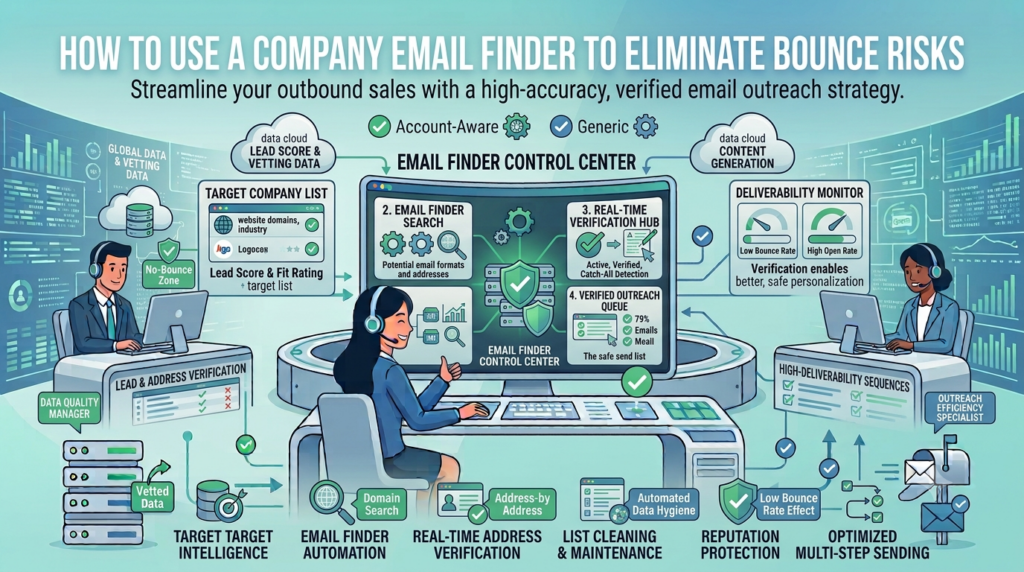
How to Use a Company Email Finder to Eliminate Bounce Risks starts with verifying email addresses before you send a single message, helping protect your sender reputation and improve deliverability.
Using a company email finder to eliminate bounce risks isn’t about finding more email addresses. It’s about finding only deliverable email addresses through pattern recognition, real-time verification, and domain validation before you ever hit send.
The strategy breaks down into three steps: validate the company email domain to ensure it’s properly configured and accepting mail, use pattern detection to identify likely email formats based on verified employees, and verify each specific address in real time before adding it to your outreach list. Skip any of these steps, and you’re gambling with your sender reputation.
Understanding How to Use a Company Email Finder to Eliminate Bounce Risks is essential because email service providers don’t just penalise individual invalid addresses. They calculate your bounce rate as a percentage of total emails sent, and anything above 2–3% can damage your sender reputation and reduce inbox placement across future campaigns.
According to research from Return Path, senders with bounce rates above 5% experience significantly lower inbox placement, meaning even valid emails become less likely to reach the primary inbox.
A professional company email finder with built-in verification eliminates this risk. Instead of guessing email addresses and hoping they work, you verify deliverability before an address ever enters your outreach system.
This guide explains How to Use a Company Email Finder to Eliminate Bounce Risks step by step, showing how domain validation, email pattern detection, and real-time verification work together to protect your campaigns. By following How to Use a Company Email Finder to Eliminate Bounce Risks, you can reduce bounce rates, improve deliverability, and maintain a stronger sender reputation while scaling your outbound outreach.
Whether you’re running small campaigns or enterprise-level outreach, learning How to Use a Company Email Finder to Eliminate Bounce Risks will help you build cleaner prospect lists and achieve more consistent cold email results.
Why Email Bounces Destroy More Than Individual Campaigns
The Reputation Cascade Effect
Most people think of bounces as isolated failures. An email doesn’t deliver, you remove that address, and you move on. That’s not how modern email infrastructure works.
Gmail, Outlook, and other major providers track sender reputation across multiple signals: bounce rates, spam complaints, engagement rates, and authentication compliance. These signals compound. A high bounce rate doesn’t just prevent those specific emails from delivering. It lowers the reputation score applied to all your future emails, making even legitimate addresses more likely to land in spam folders.
Research published in the Journal of Interactive Marketing found that sender reputation affects deliverability for 60-90 days after the behavior that triggered the penalty. One bad campaign with a 15% bounce rate can damage your inbox placement for the next three months, affecting every campaign you run during that window.
The Domain Reputation Problem
When you send from your company domain, bounces don’t just affect your individual email account. They damage the reputation of your entire domain. This matters especially for companies doing both outbound sales and transactional emails (receipts, password resets, notifications).
Your sales team’s sloppy prospecting with high bounce rates can cause your transactional emails to land in spam. Customer support tickets sent via email might not reach customers. Password reset links could get filtered. The domains aren’t isolated, and the damage spreads.
This is why sophisticated teams use dedicated domains for cold outreach, separate from their primary business domain. But even with domain separation, you still need to maintain a reputation on those outreach domains, or they become useless.
How Company Email Finders Actually Work
Pattern Detection and Domain Validation
Every company follows email format conventions: firstname.lastname@company.com, firstname@company.com, firstinitiallastname@company.com, and so on. Company email finders identify these patterns by analyzing known valid emails from the target domain.
The process starts with a company email domain lookup to verify the domain is properly configured with MX (mail exchange) records and is actively accepting email. Tools query DNS records to confirm mail servers exist and respond appropriately.
Next comes pattern detection. By finding verified emails for existing employees (often from public sources like press releases, bylines, or LinkedIn), the tool identifies the format convention that the company uses. If you find john.smith@acmecorp.com and sarah.jones@acmecorp.com in public records, you can confidently infer the pattern is firstname.lastname@acmecorp.com.
The corporate email finder then applies this pattern to construct likely addresses for other employees at the same company. But here’s the critical part: construction isn’t confirmation. The next step is verification.
Real-Time Verification Technology
Modern email verification works through SMTP validation without actually sending emails. The verification system connects to the recipient’s mail server and simulates the beginning of an email delivery to check if the address exists and can receive mail.
This happens in milliseconds through a process called SMTP handshake. The verification tool asks the mail server, “Would you accept mail for john.doe@targetcompany.com?” The server responds with either acceptance (250 OK) or rejection (550 User Unknown), which confirms deliverability without burning your sender reputation with actual bounces.
Some advanced systems also check for catch-all domains (which accept all email addresses regardless of validity), disposable email addresses, and role-based addresses (info@, sales@) that often have poor engagement rates.
According to data from Validity’s Email Fraud & Identity Deception Trends report, SMTP verification catches 98% of invalid addresses before sending, compared to 60-70% accuracy for syntax-only validation.
The Catch-All Domain Challenge
Catch-all domains present a unique verification problem. These domains are configured to accept email for any address at their domain, whether the mailbox actually exists or not. The SMTP verification returns “valid” for every address you check, but many of those addresses lead to black holes or inactive mailboxes.
Sophisticated company email finders flag catch-all domains and provide confidence scores rather than binary valid/invalid results. An address at a catch-all domain might be marked “75% confidence” based on whether the name pattern matches known employees and other signals.
For catch-all domains, engagement verification becomes critical. You might need to actually send a low-risk email (not a sales pitch) and measure whether it’s opened or clicked to confirm someone’s actually receiving mail at that address.
The Flat-Fee Advantage for Verification-Heavy Workflows
Here’s where SmartProspect’s pricing model specifically solves the bounce risk problem: at $59/month flat rate with unlimited searches, you’re incentivized to verify aggressively rather than conservatively.
Most email finder tools charge per verification or per credit. This creates a perverse incentive to verify less thoroughly to conserve credits. You might skip re-verification of older contacts, avoid checking multiple potential patterns, or take chances on medium-confidence addresses to preserve your monthly allowance.
With flat-fee pricing, the calculus reverses. Verify everything. Check multiple name variations. Re-verify your database quarterly. Run redundant checks on high-priority prospects. There’s no financial penalty for being thorough, which is exactly how you eliminate bounce risks.
Integration with Deliverability Infrastructure
SmartProspect isn’t a standalone tool you export CSVs from. It’s integrated directly into Smartlead’s outreach infrastructure, which means verified email addresses flow immediately into campaigns backed by proper deliverability management.
The platform automatically distributes your outreach across multiple warmed domains, monitors bounce rates in real-time, and throttles sending if deliverability issues emerge. You’re not just finding verified emails. You’re using them in a system designed to maintain the sender’s reputation, which makes those emails effective.
This integration is where the value compounds. Other corporate email finders give you data, then leave you to figure out how to use it without destroying deliverability. SmartProspect gives you data within a system that protects deliverability by design.
Step-by-Step Process for Zero-Bounce Prospecting
Step 1: Company Identification and Domain Validation
Start by identifying target companies that match your ICP. Before you search for individual contacts, validate that the company’s email domain is properly configured and actively accepting mail.
Use company email domain lookup tools or even simple command-line utilities (nslookup, dig) to check MX records. If a company’s domain doesn’t have valid MX records, no email addresses at that domain will work, regardless of how accurately you construct them.
This step filters out companies with misconfigured email systems, newly registered domains that haven’t set up mail yet, or organizations using third-party email hosting that requires different domain patterns (like Gmail for Business).
Step 2: Pattern Detection with Multiple Data Points
Never rely on a single data point to determine email patterns. Find at least three verified emails from the target company before confidently applying that pattern to other prospects.
Sources for pattern detection include: company press releases with contact information, article bylines, podcast guest bios, conference speaker lists, GitHub commits, LinkedIn profiles with contact info, and the company’s own team page if they publish email addresses.
If you can only find one or two verified emails, treat any constructed addresses as low-confidence until you can verify them individually. Pattern detection with insufficient data leads to systematic errors that create bounce rates even when your verification process works correctly.
Step 3: Real-Time Verification Before List Import
This is the step that most people skip and regret later. Before importing discovered email addresses into your CRM or outreach tool, run them through real-time SMTP verification.
Batch verification services like NeverBounce, ZeroBounce, or built-in verification in tools like SmartProspect check deliverability in bulk. Set a strict threshold: only import addresses with “valid” status, and quarantine anything marked “unknown,” “catch-all,” or “risky” for manual review.
For high-value prospects marked as “unknown,” invest time in manual verification through LinkedIn messages or phone calls to confirm their email address directly. For lower-priority prospects with uncertain deliverability, skip them entirely rather than risking reputation damage.
Step 4: Engagement-Based Re-Verification
Email addresses that verify as deliverable today might bounce tomorrow. People change jobs, companies restructure, and mailboxes get deactivated. Implement ongoing verification based on engagement patterns.
Any contact with zero engagement (no opens, no clicks, no replies) for 90 days should be re-verified before additional outreach. Contacts with recent engagement are confirmed valid by definition since they’re interacting with your emails.
This creates a self-optimizing database where your most engaged contacts are always verified, and your inactive contacts get filtered out before they start bouncing and damaging your reputation.
The Technical Details That Prevent Bounces
Understanding Bounce Types and What They Mean
Hard bounces occur when email addresses are permanently invalid: the mailbox doesn’t exist, the domain doesn’t exist, or the email server explicitly rejects the address. These are the bounces that destroy the sender’s reputation and must be eliminated entirely through proper verification.
Soft bounces happen when temporary issues prevent delivery: the mailbox is full, the server is temporarily unavailable, or the message is too large. Soft bounces don’t damage reputation as severely, but persistent soft bounces (same address bouncing repeatedly) eventually get reclassified as hard bounces.
Company email finders with verification prevent hard bounces. You can’t prevent all soft bounces (you can’t control if someone’s mailbox fills up), but you can ensure that your bounce rate stays below the 2% threshold that triggers reputation penalties.
SPF, DKIM, and DMARC: The Authentication Trifecta
Even with perfectly verified email addresses, you’ll still see deliverability problems if your sending domain isn’t properly authenticated. SPF (Sender Policy Framework), DKIM (DomainKeys Identified Mail), and DMARC (Domain-based Message Authentication, Reporting, and Conformance) are required for serious cold outreach.
These protocols prove to receiving servers that you’re authorized to send from your domain and that your emails haven’t been tampered with in transit. Gmail and Outlook now require proper authentication, and emails from unauthenticated domains are increasingly filtered to spam regardless of content quality.
A corporate email finder doesn’t solve authentication problems, but using one without proper authentication is like buying premium fuel for a car with a broken engine. Fix the fundamentals first, then layer in quality data.
Monitoring Reputation in Real-Time
Use sender reputation monitoring tools like Google Postmaster Tools, Microsoft SNDS (Smart Network Data Services), and dedicated platforms like 250ok or Validity to track your reputation scores across major email providers.
These tools show bounce rates, spam complaint rates, and reputation trends before they become critical problems. If you see reputation declining despite using verified addresses, you can identify and fix issues (content triggers, engagement problems, authentication failures) before they cause lasting damage.
Most email service providers won’t tell you directly why they’re filtering your mail, but reputation monitoring tools provide the signals you need to diagnose and correct problems.
Common Mistakes That Still Cause Bounces
Trusting Old Data Without Re-Verification
The average B2B contact changes jobs every 3-5 years, and email addresses at their old company stop working immediately. A perfectly verified email from six months ago might bounce today if that person left the company.
Implement regular re-verification schedules. Quarterly for active outreach lists, annually for your entire database. This catches job changes, company acquisitions that change email domains, and mailbox deactivations before they become bounce problems.
SmartProspect’s flat-fee model makes aggressive re-verification economically feasible. With per-credit tools, teams often skip re-verification to save costs, then suffer bounce rates from outdated data.
Ignoring Role-Based and Shared Mailbox Addresses
Company email finders often return role-based addresses: info@, sales@, support@, contact@. These addresses technically verify as deliverable, but they’re almost never the right targets for personalized outreach.
Role-based addresses typically have poor engagement rates (multiple people see them, nobody feels personally responsible), higher spam complaint rates (they receive massive volumes of unsolicited email), and they don’t satisfy the personalization that makes cold outreach effective.
Filter out role-based addresses even when they verify successfully. You want individual decision-makers, not shared inboxes where your carefully crafted message gets lost in noise.
Sending to Verification Without Warmup
Even verified email addresses sent from cold domains or IP addresses will bounce or land in spam. Verification confirms the recipient address is valid, but it doesn’t guarantee your sending infrastructure is trusted.
New domains and IP addresses need gradual warmup: starting with small send volumes to highly engaged contacts, slowly increasing volume over 2-4 weeks while maintaining strong engagement rates. Rush this process, and even perfectly verified addresses will bounce or get filtered.
Smartlead’s infrastructure includes automated warmup protocols that gradually increase sending volume across your email accounts. This ensures that by the time you’re running full campaigns with your verified prospect lists, your domains have established the reputation needed for inbox placement.
Advanced Verification Strategies for Enterprise Teams
Multi-Source Validation
Don’t rely on a single verification method. Layer multiple approaches: SMTP verification for basic deliverability, LinkedIn profile confirmation for employment verification, and engagement tracking for ongoing validation.
Enterprise teams often use “verification chains” where addresses must pass SMTP verification, have LinkedIn profile matches, AND show company affiliation in multiple public sources before being classified as high-confidence.
This redundancy catches edge cases that single-method verification misses: SMTP might confirm an address exists but miss that it’s a honeypot spam trap, LinkedIn confirms employment but might not catch that someone left the company last week.
Honeypot and Spam Trap Detection
Email honeypots and spam traps are deliberately placed invalid addresses designed to catch spammers and bad actors. Hit one of these, and your sender reputation takes immediate, severe damage.
Sophisticated verification services maintain databases of known spam traps and honeypot addresses. They’ll flag these addresses even if they technically verify through SMTP, protecting you from reputation destruction.
Never buy email lists from third parties. These lists are notorious for containing spam traps, which is exactly why list sellers can sell millions of “verified” addresses cheaply. The data isn’t valuable because it’s contaminated with reputation-destroying traps.
Engagement-Based Confidence Scoring
Build confidence scores for every email address based on multiple factors: verification status, data recency, public profile matches, engagement history, and how the address was sourced.
High-confidence addresses (95-100%): verified within 30 days, LinkedIn profile matches, recent engagement, or public activity. Use these freely.
Medium-confidence addresses (70-94%): verified but older data, pattern-based construction with strong supporting signals. Use selectively for high-value prospects.
Low-confidence addresses (below 70%): catch-all domains, weak verification signals, old data. Skip these entirely unless you can manually confirm through other channels.
Measuring Success: Metrics That Actually Matter
Bounce Rate Targets and Thresholds
Your hard bounce rate should be below 1% consistently. Anything above 2% indicates serious data quality problems. Above 5% and you’re actively destroying sender reputation with every campaign.
Soft bounce rates below 5% are acceptable, but watch for patterns. The same addresses bouncing repeatedly indicate mailbox problems that might become hard bounces. Systematic soft bounces across many addresses at the same domain might indicate server configuration issues rather than individual address problems.
Track bounce rates by source. If manually researched emails bounce at 0.5% but emails from a specific company email finder bounce at 8%, you know that the tool isn’t verifying properly and needs to be replaced.
Inbox Placement Rate
Deliverability isn’t binary. Emails that don’t bounce might still land in spam folders, achieving technical delivery without actual inbox placement. Monitor inbox placement through seed list testing or dedicated monitoring tools.
Industry benchmark for cold outreach is 65-75% inbox placement for properly authenticated, warmed domains with verified contact lists. If you’re below 50%, verification might not be your problem. Look at content triggers, sending patterns, or authentication issues.
Response Rate as Validation
Your response rate indirectly validates data quality. With properly verified emails reaching decision-makers who match your ICP, response rates should be 2-8% depending on industry and offer quality.
Response rates below 1% despite good bounce rates, suggest you’re reaching real email addresses but not the right people. This indicates problems with pattern detection or targeting rather than verification failures.