
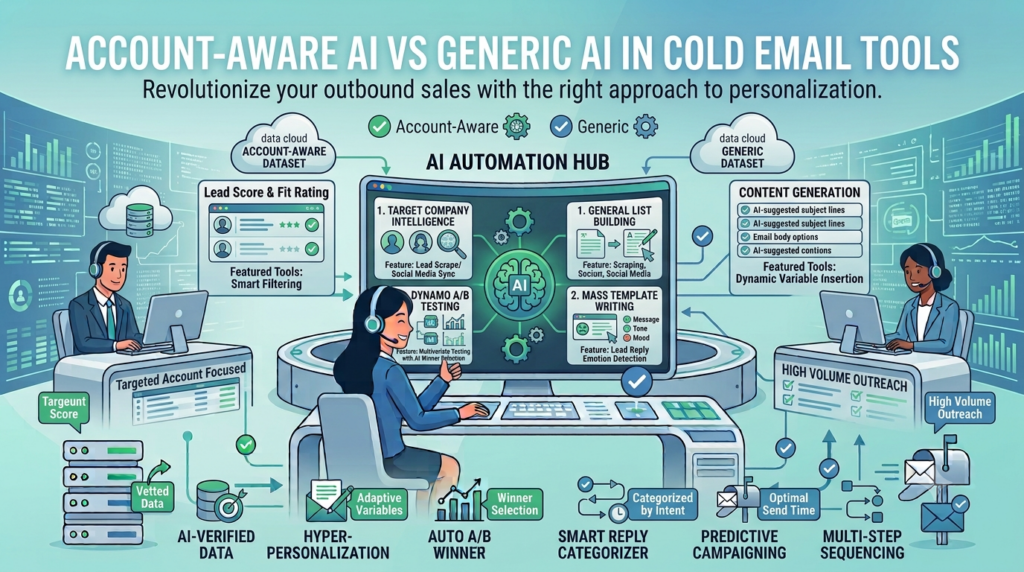
Account Aware AI vs Generic AI In Cold Email Tools is the difference between AI that simply generates text and AI that understands the real-time health and performance of your cold email account.
Most AI in cold email tools does not know anything about your account. It writes a subject line based on a prompt you provide. It generates an email body based on your chosen tone. It classifies replies using only the words in the response. None of that AI looks at your active campaigns, mailbox health, warmup progress, bounce rates, DNS records, or what is actually happening inside your account.
That is generic AI. It can be useful, but it offers the same experience you would get by opening a separate AI chat tool and asking the same question. The cold email platform is simply providing a different interface.
Understanding Account Aware AI vs Generic AI In Cold Email Tools is important because account-aware AI works differently. Instead of relying only on prompts, it has access to your live account data. It monitors campaign performance, sender reputation, deliverability metrics, and mailbox activity to provide recommendations based on your actual situation.
The same question can produce a completely different answer because the AI is analysing a different account with different performance data. That makes its recommendations more relevant and actionable than those of a generic AI assistant.
This guide explains Account Aware AI vs Generic AI In Cold Email Tools, showing how each approach affects personalization, deliverability, automation, and campaign optimisation. By understanding Account Aware AI vs Generic AI In Cold Email Tools, you can choose AI features that improve real-world outbound performance rather than simply generating better email copy.
This article is about what changes when AI can see your account.
What does generic AI actually do?
Generic AI in a cold email tool is mostly about writing. You give it a prompt, it gives you text. The prompt could be a subject line ask, a body copy ask, a personalization ask, a follow up ask. The output is fine, sometimes good, sometimes not. It is the same kind of AI you would get from any general purpose chat tool.
A few specific examples of what generic AI looks like inside cold email tools.
- AI email writer that takes a description of your offer and writes a draft sequence
- AI subject line generator that produces five variations
- AI personalization feature that fills in the first name and company on a template
- AI reply detector that classifies replies as interested, not interested, or unsubscribe
All of these are useful but none of them know anything about your account. Two different users running two different campaigns with two completely different mailbox setups would get the same answer to the same question, because the AI is not looking at the difference.
What does account aware AI actually do?
Account aware AI looks at your live account data when you ask it something. It knows which mailboxes you have connected, what their warmup status is, what their bounce rate is, which campaigns are running, which leads are in those campaigns, what the reply rate is, what the DNS records on your sending domains look like, what your sending history is for the last thirty days.
When you ask a question, the answer comes back specific to your account and not generic advice. Specific advice for what is happening on your data right now.
A few specific examples of the difference.
Question. Why are my emails landing in spam.
Generic AI says, here are ten things to check. SPF, DKIM, DMARC, sender reputation, content, links, warmup, sending volume, list hygiene, mailbox health. Go through the list and see what applies.
Account aware AI says, your sending domain has DKIM configured correctly and SPF configured correctly, but DMARC is missing. Two of your three mailboxes have been warming for less than two weeks, which is too short for the volume you are sending. Your bounce rate on the last campaign was 6%, which is high enough to be hurting your sender reputation. Here is what to fix first.
The first answer takes you an hour to work through. The second answer takes you ten minutes.
Question. Should I increase my daily sending limit.
Generic AI says, that depends on your warmup status and your mailbox age. Generally, mailboxes that have been warming for four to six weeks can handle around thirty to fifty emails a day, and you can scale from there. Watch your bounce rate.
Account aware AI says, your two oldest mailboxes have been warming for forty seven and forty two days, and the inbox placement rate from the warmup network is above ninety percent. You can safely increase those to forty a day. Your newest mailbox has been warming for nineteen days, you should keep that one at fifteen a day for another two weeks before increasing it.
Same question. Two very different answers. The second one is something you can actually act on.
Where does this matter most?
These are the places where account aware AI changes the most.
Deliverability questions. Generic AI can tell you what causes spam placement in general. Account aware AI can tell you which specific thing on your account is causing spam placement right now. Most cold email pain is deliverability pain, so this is the area where the difference shows up first.
Diagnostics on broken campaigns. When something is wrong, generic AI gives you a checklist. Account aware AI tells you the cause. The difference is, with generic AI, you spend twenty minutes checking ten things. With account aware AI, you fix the one thing that is actually broken.
Personalization at scale. Generic AI personalization fills in placeholders for first name and company. Account aware AI can also see which fields exist on your leads, which fields are missing on which leads, and which leads should be skipped because they do not have enough data for a personalized email to make sense.
Recommendations on next actions. Generic AI can suggest cold email best practices. Account aware AI can suggest the best practices that apply to your specific setup. The recommendations are filtered by what you have already done and what you have not.
Reply handling. Generic AI classifies replies by intent. Account aware AI can also tell you which campaign the reply came from, what the open rate on that campaign is, what the previous emails in that thread looked like, and whether the prospect has replied to any of your past campaigns.
What is deeply embedded vs latched on AI?
The way to think about this is that most AI in cold email tools is latched on. The cold email tool added an AI feature, usually a writing feature, sometimes a reply detection feature, on top of a product that was already built. The AI sits next to the product. It does not see the product data.
Deeply embedded AI is built into the product. The AI sees your account, takes actions in your account, navigates between pages in your account, and pulls data from every part of the product when you ask a question. It is not a feature, it is an assistant that uses the whole product.
Other categories have started doing this. The way Notion AI works inside Notion, where it can read your documents, search across them, and write inside the document you are looking at, is the same idea. The way ClickUp Brain works inside ClickUp, where it can search across tasks and write inside the task you have open, is also the same idea. Both of those are deeply embedded AI in their categories.
Did using an AI bot really get someone banned
This question comes up enough that it is worth answering directly. Using an AI bot to send cold emails does not get you banned by itself. What gets you banned is sending high volumes of low quality emails from a poorly warmed mailbox to a list with bad data. AI or no AI, the same things hurt deliverability.
The difference an account aware assistant makes is that it is looking at your warmup status, your bounce rate, and your sending volume in real time, so it can warn you before you do the thing that gets your domain hurt. Generic AI cannot do that because it does not know what state your account is in.