
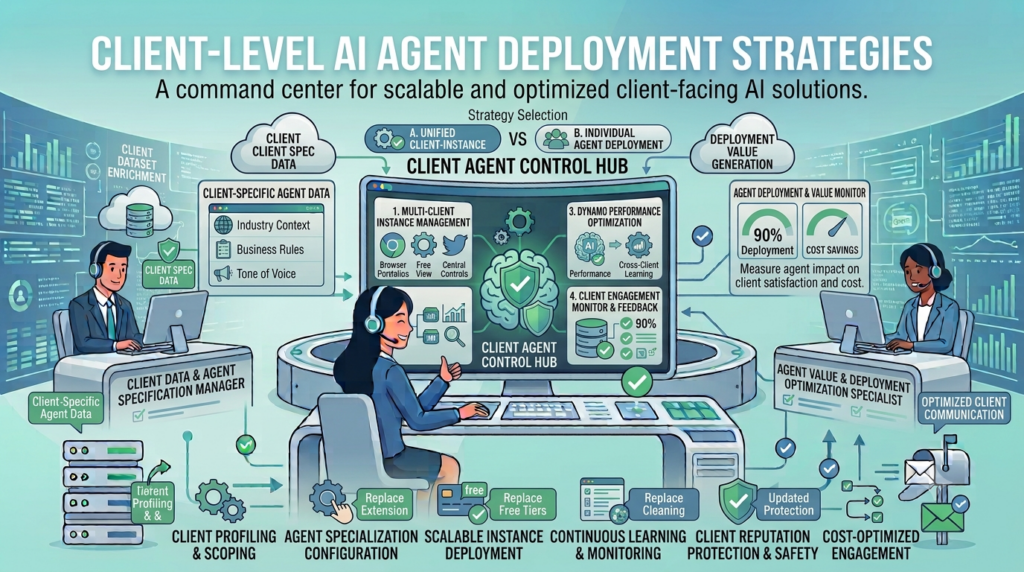
Client-Level AI Agent Deployment Strategies enable businesses to deploy secure, scalable AI agents for multiple clients while maintaining complete data isolation and efficient infrastructure management.
Client-level agent deployment involves creating isolated, scalable AI instances where multiple clients share the same underlying infrastructure without sharing data. Each client operates in its own secure environment while benefiting from shared resources that reduce operational costs and simplify maintenance.
Think of it like an apartment building: each tenant has a private, secure space with customised features, but everyone benefits from shared utilities, maintenance, and infrastructure without accessing another tenant’s unit.
Client-Level AI Agent Deployment Strategies is essential for organisations that want to scale AI services efficiently. The most effective approach combines multi-tenant architecture for shared resources with logical isolation, white-label customisation that reflects your brand instead of the vendor’s, and orchestration frameworks that simplify deployment, monitoring, and scaling across dozens or even hundreds of client accounts.
Companies that successfully implement Client-Level AI Agent Deployment Strategies often reduce infrastructure costs by 25–40% compared to traditional single-tenant deployments while shortening implementation timelines from months to just days.
Recent industry research also shows that AI agent adoption continues to accelerate across organisations. Businesses that delay deploying scalable AI solutions risk falling behind competitors that are already automating customer support, sales, operations, and internal workflows.
This guide explores Client-Level AI Agent Deployment Strategies, including multi-tenant architecture, security, white-label deployment, orchestration, and best practices for managing AI agents at scale. By adopting the right Client-Level AI Agent Deployment Strategies, organisations can lower costs, improve operational efficiency, and deliver customised AI experiences to every client without rebuilding systems for each deployment.
Multi-Tenant AI Architecture
Multi-tenant AI architecture is the backbone of scalable client deployments. It allows a single AI system instance to serve multiple clients (tenants) while maintaining strict boundaries between their data, configurations, and operations.
What Makes Multi-Tenant Different
Traditional single-tenant systems give each client a completely separate infrastructure stack. Every new client means new servers, databases, and deployment pipelines. It’s secure, sure, but it’s also expensive, slow, and operationally nightmarish when you’re managing 50 clients.
Multi-tenant architecture flips this model. One shared infrastructure serves everyone, but smart isolation mechanisms ensure Client A can’t peek at Client B’s data, models can be customized per tenant, and performance degradation from one heavy user doesn’t tank everyone else.
Microsoft Azure’s research on multi-tenant AI emphasizes three critical isolation levels:
Data Isolation
Each tenant’s data lives in logically separated storage, typically using row-level security or schema isolation. Even though everyone shares the same database infrastructure, the data never mingles.
Model Isolation
Depending on requirements, you can deploy one shared model across all tenants (cost-efficient but less personalized) or dedicated models per tenant (more expensive but allows custom training). Most successful implementations use a hybrid approach where base models are shared, but fine-tuning is tenant-specific.
Compute Isolation
Resource allocation strategies prevent the “noisy neighbor” problem, where one client’s heavy usage slows down others. This involves quota management, request throttling, and dynamic resource scaling.
Deployment Patterns That Actually Work
AWS’s prescriptive guidance on multi-tenant AI identifies three practical patterns:
Pooled Model
All tenants share everything: infrastructure, models, and compute resources. This is your lowest-cost option but requires sophisticated access controls and monitoring. Best for agencies serving SMBs with similar use cases.
Siloed Model
Each tenant gets dedicated resources. Higher cost, maximum isolation. Use this when handling regulated industries (healthcare, finance) or clients with massive scale requirements that justify the expense.
Bridge Model
Shared infrastructure for stable components (LLM APIs, orchestration layers), dedicated resources for sensitive operations (data storage, custom model training). This hits the sweet spot for most agencies—you get cost efficiency without compromising security or customization.
Hypermode’s analysis shows multi-tenant deployments typically cut infrastructure costs by 30-40% while enabling centralized updates that benefit all tenants simultaneously, a stark contrast to single-tenant systems, where every update requires individual deployment across dozens of client instances.
How to Deploy AI Agents for Multiple Clients
Deploying AI agents at scale isn’t just about spinning up more servers. It requires strategic architecture, robust governance, and operational discipline that most agencies skip straight past in their rush to market.
Phase 1: AI Agent Architecture Foundation
Start with your orchestration layer. Tools like LangGraph, Amazon Bedrock Agents, or custom implementations using Claude API with MCP servers give you the framework to manage agent lifecycles across multiple tenants.
A 2024 survey by LangChain reveals that 51% of respondents are already using AI agents in production, while 78% have plans to deploy them in the near future. The ones succeeding aren’t building everything from scratch; they’re leveraging platforms that handle the heavy lifting.
Your architecture needs three core layers:
1. Agent Registry
A centralized system tracking which agents exist, their versions, configurations, and which tenants have access. Think of this as your source of truth for what’s deployed where.
2. Tenant Management Layer
Handles authentication, authorization, resource quotas, and billing. This is where you map customers to their specific agent configurations and enforce isolation policies.
3. Execution Environment
The actual compute layer running agents, whether that’s containers on Kubernetes, serverless functions, or managed services like Amazon Bedrock. The key is making this layer tenant-aware so agents automatically operate within the correct customer context.
Phase 2: Isolation Mechanisms
Data isolation isn’t optional; it’s the difference between a production system and a compliance nightmare waiting to happen.
In a multitenant context, consider whether models should be deployed to shared compute resources or if each tenant has dedicated resources. Your isolation strategy should match your clients’ security requirements, not just your operational preferences.
Implement these non-negotiables:
API Gateway with Tenant Context
Every API request must carry tenant identification (typically through secure tokens). Your gateway validates this before routing requests to the appropriate tenant context.
Database-Level Segmentation
Use row-level security (RLS) policies or schema separation. Never rely solely on application-level filtering—that’s one bug away from a data breach.
Resource Quotas
Prevent runaway costs and ensure fair usage by implementing per-tenant limits on API calls, compute time, and storage. Make these configurable because your enterprise clients will have different needs than your SMB customers.
Phase 3: AI Agent Deployment Pipeline
Your CI/CD pipeline needs to be multi-tenant aware from day one. When you push an agent update, you need granular control over which tenants receive it and when.
Containerization through Docker and Kubernetes enables consistent environments across development and production, eliminating environment-specific issues.
Implement progressive rollout strategies:
- Canary Deployments: Roll out to 5% of tenants first, monitor for errors, then gradually expand
- Tenant-Specific Versioning: Let enterprise clients stay on stable releases while others get cutting-edge features
- Automated Rollback: When things break (and they will), your system should automatically revert to the last known good configuration
When working with only a few AI agents, reviewing their work and spotting errors can be mostly straightforward. But as companies roll out hundreds, or even thousands, of agents, the task becomes challenging. This is why observability isn’t optional.
Phase 4: Monitoring and Governance
Organizations are reporting an average of 18 months from pilot to full deployment, with success rates improving from 35% in 2023 to 65% in 2025. What’s the difference between the 35% failures and the 65% successes? Proper monitoring and governance of AI agent frameworks.
Deploy comprehensive observability:
- Performance Metrics: Track response times, error rates, and throughput per tenant. You need to know when Client A’s massive job is affecting Client B’s experience.
- Cost Attribution: Monitor token usage, API calls, and compute costs per tenant. Your billing system depends on accurate tracking, and clients will demand transparency.
- Quality Metrics: Measure agent accuracy, task completion rates, and user satisfaction. These metrics inform whether your agents are actually delivering value or just burning money.
- Security Auditing: Log all access, especially to sensitive operations. Regulatory compliance isn’t negotiable, and you’ll thank yourself later when (not if) you face an audit.
White-Label AI Agents: Building Your Own Brand
White-labeling transforms third-party AI infrastructure into your own branded product. Done right, clients never know you’re not running everything in-house. Done wrong, and the vendor’s logo showing up in error messages kills your credibility faster than you can say “technical difficulties.”
What True White-Labeling Means
White-labeling goes far beyond removing someone else’s logo. It’s about creating a seamless brand experience across every touchpoint:
Complete UI Customization
Your colors, fonts, layouts—not just a logo slapped on someone else’s dashboard. Platforms like Stammer AI and BotPenguin offer this level of control, letting you embed their technology under your own domain with zero vendor attribution.
Custom Domains
Clients access agents at youragency.ai, not thirdpartyplatform.com/youragency. This matters more than you think—trust and perceived value skyrocket when the URL matches your brand.
White-Labeled Documentation
API docs, user guides, error messages—everything should reference your company, not the underlying provider. Your clients are buying from you, not from your infrastructure vendor.
Billing and Support Under Your Brand
When clients have issues or questions, they contact your support channels. The vendor stays invisible. Some platforms like Lety.ai even handle billing infrastructure so you can charge clients directly under your own payment processing.
Choosing a White-Label Platform
The white-label AI market exploded in 2025, with dozens of platforms competing for agency business. Here’s what separates the real solutions from the vaporware:
Zero Revenue Sharing
Platforms like Stammer AI explicitly state “no revenue sharing, ever.” You set pricing, you keep 100% of the markup. Anything less is the platform taxing your client relationships.
Technical Flexibility
Can you connect your own OpenAI or Anthropic API keys? Do they support custom integrations? Restricted platforms lock you into their ecosystem and their pricing.
Multi-Tenant Management
The platform should natively support unlimited client accounts with data isolation built in. If you’re manually configuring each client deployment, the platform has failed its one job.
Deployment Options
Voice, chat, email, SMS; your clients will want agents everywhere. Platforms that only do chatbots are already obsolete.
Practical Implementation Example
Say you’re deploying an AI SDR agent for 20 clients. With a white-label platform:
- You create one master configuration with your agency’s branding
- Clone it for each client, customizing prompts and integrations
- Deploy under custom subdomains: client1.youragency.ai, client2.youragency.ai
- Set per-client pricing—maybe $499/month for SMBs, $1,200/month for enterprise
- What is your actual cost to the platform? Roughly $12-50/month, depending on usage
- You pocket the difference: $487-$1,188 profit per client monthly
Scale that across 50 clients and you’re looking at $24,000-$59,000 in monthly recurring revenue from a single productized offering. No wonder agencies are racing to white-label everything.
How Agencies Deploy AI for Clients
Real agencies deploying AI at scale aren’t following theoretical frameworks from consultants who’ve never managed a production deployment. They’re battle-testing approaches in the field and iterating fast.
The Pragmatic Agency Playbook
Justin Belmont, Founder and CEO at Prose and former Editor-in-Chief at Google, explains: “We started small—testing tools on internal projects and seeing what stuck. Once we nailed down the workflow, we scaled it up for client work. It wasn’t a big-bang launch; it was a series of little wins”.
This “small wins first” approach is the consistent pattern among successful deployments:
- Start Internal: Deploy AI agents for your own sales, customer service, or content operations. This de-risks the technology while giving you real experience before touching client accounts.
- Pilot with Friendly Clients: Choose 2-3 clients who are technically savvy and willing to experiment. Get their feedback, iterate on the implementation, and build case studies proving ROI.
- Productize the Successful Patterns: Once you’ve solved the same problem three times, turn it into a standard offering. Create templates, documentation, and pricing packages.
- Scale Systematically: Use your multi-tenant infrastructure and white-label platform to deploy to 10, then 50, then 100+ clients without rebuilding everything each time.
Managing Client Expectations
Here’s where agencies stumble: AI agents are powerful but not magic. Set the wrong expectations and you’re stuck explaining why the “AI that was supposed to do everything” needs human oversight.
Ryan Anderson, President at Markiserv, notes: “We’ve had clients switch to us because their previous agencies used AI without disclosing it”. Transparency isn’t just ethical; it’s a competitive advantage. Clients respect agencies that are upfront about AI’s role rather than trying to pass off AI-generated work as purely human-created.
Be explicit about:
- What AI Handles: Routine queries, data processing, initial drafts, pattern recognition—tasks where AI excels and frees humans for strategic work.
- What Requires Humans: Strategy, nuanced judgment, creative direction, and relationship building. AI augments these; it doesn’t replace them.
- Performance Metrics: Define success upfront. If you promise an AI chatbot will resolve 80% of customer queries, you’d better have the data architecture to track that metric accurately.
Training and Change Management
As one business leader describes it: “Onboarding agents is more like hiring a new employee versus deploying software”. Agents need clear job descriptions, training, and ongoing feedback loops to improve performance.
Your deployment should include:
- Client Team Training: 60-90 minute sessions showing client teams how to interact with agents, review outputs, and provide feedback that improves performance.
- Documentation Packages: Written guides, video walkthroughs, and FAQ documents. Clients should never feel lost when using your AI solutions.
- Feedback Loops: Regular check-ins (weekly for the first month, then monthly) to review agent performance, gather improvement suggestions, and adjust configurations.
Real-World Agency Models
High-performing agencies are deploying AI across four primary models:
Done-For-You Service
You build, deploy, and maintain AI agents as a managed service. Clients pay a monthly fee, and you handle everything. This commands premium pricing but requires a strong support infrastructure.
Platform Access
You provide white-labeled access to AI agent tools, and clients configure agents themselves with your guidance. Lower touch, lower margin, but scales infinitely.
Hybrid Consulting
You consult on AI strategy and implementation while partnering with clients’ internal teams to deploy solutions. Best for enterprise clients with technical capabilities.
Usage-Based Reselling
You mark up API calls and agent usage, taking a percentage of transaction volume. This aligns your revenue with client success but requires sophisticated billing systems.
AI Infrastructure Deployment Best Practices
Getting the infrastructure right is the difference between a system that scales gracefully and one that collapses under load at the worst possible moment (usually right after you close your biggest client).
Cloud Architecture Decisions
Most successful deployments use managed cloud services rather than building everything from scratch. Amazon Bedrock, Azure OpenAI Service, or API access to Claude and other frontier models give you enterprise-grade reliability without managing infrastructure.
Compute Strategy
Serverless functions (AWS Lambda, Azure Functions) handle variable loads efficiently. You’re not paying for idle servers during off-peak hours, but you scale instantly when 20 clients hit your agents simultaneously.
Data Storage
Separate databases per tenant or sophisticated RLS on shared databases. Never commingle client data in ways that could leak across tenants. Use managed database services (RDS, Cosmos DB) that handle backups, scaling, and security patches automatically.
Implement an API gateway that handles authentication, rate limiting, and request routing. This is your control plane for managing tenant access and preventing abuse.
Security and Compliance Frameworks
Overall, 51 percent of respondents from organizations using AI say their organizations have seen at least one instance of a negative consequence, with nearly one-third of all respondents reporting consequences stemming from AI inaccuracy.
The compliance requirements vary dramatically by industry:
- Healthcare (HIPAA): Encrypted data at rest and in transit, audit logs for all access, business associate agreements with all vendors, and regular security assessments.
- Finance (SOC 2, PCI-DSS): Strong access controls, data retention policies, regular penetration testing, and incident response procedures.
- EU Clients (GDPR): Data residency requirements, right to deletion, consent management, data processing agreements.
Build these into your architecture from day one. Retrofitting compliance is exponentially more expensive than designing for it up front.
Cost Optimization Without Compromising Quality
AI agents aren’t cheap to run. GPT-4 calls add up fast, and compute costs can spiral if you’re not careful.
- Caching Strategies: Cache common responses at multiple levels. If 50 clients ask similar questions, don’t hit the LLM 50 times—cache and reuse responses where appropriate.
- Model Selection: Not every task needs GPT-4. Route simple queries to faster, cheaper models (Claude Haiku, GPT-3.5) and reserve powerful models for complex reasoning tasks.
- Batch Processing: Where possible, batch API requests rather than making individual calls. This reduces overhead and often qualifies for volume discounts.
- Monitoring and Alerting: Track costs per tenant in real-time. Set budget alerts so you know immediately if a client’s agent starts consuming resources abnormally.
Scaling from 10 to 100+ Clients
The strategies that work for 10 clients often break catastrophically at 100 clients. Scaling requires different thinking about operations, support, and infrastructure management.
Operational Automation
Manual deployment processes don’t scale. Period. At 10 clients, you can afford to spend an hour configuring each new deployment. At 100 clients, that’s 100 hours of pure overhead for every configuration change.
Automate everything:
- Client Onboarding: Self-service portals where new clients activate accounts, configure basic settings, and start using agents within minutes instead of waiting days for your team to manually provision resources.
- Configuration Management: Infrastructure-as-code approaches where client configurations live in version-controlled templates. Updating 100 clients means updating one template and pushing changes systematically.
- Billing and Invoicing: Automated usage tracking, invoice generation, and payment collection. Manual billing at scale is a nightmare that creates cash flow problems and customer support headaches.
Scaling AI support workflows this way works best with a tiered structure, where routine queries have clear resolution paths and complex cases are escalated.
Customer service AI agents now resolve 80% of queries without human intervention, up from 45% in 2023. Use your own AI agents to support your clients. It’s not just ironic; it’s strategic.
Implement tiered support:
Level 1: AI-Powered Self-Service
Documentation, chatbots, and automated troubleshooting handle common questions. This should resolve 70-80% of inquiries without human involvement.
Level 2: Technical Support Team
Human specialists handle complex issues, unusual configurations, and escalations. This team needs deep product knowledge and direct access to client systems.
Level 3: Engineering
Reserved for actual bugs, architectural issues, and feature requests. Only 5-10% of support tickets should reach this level if levels 1 and 2 are working properly.
Performance at Scale
Jensen Huang of NVIDIA opened CES 2025 by declaring it the “Year of AI Agents,” projecting that these autonomous programs represent a “multi-trillion dollar opportunity”. But that opportunity only materializes if your systems can handle the load.
Infrastructure requirements change dramatically with scale:
Database Performance
What worked for 10 tenants might crawl with 100. Implement database sharding, read replicas, and query optimization strategies.
API Rate Limiting
Protect your infrastructure and ensure fair usage by implementing sophisticated rate limiting per tenant, per endpoint, and globally.
Caching Layers
Multi-level caching (application-level, CDN, database query caching) becomes mandatory, not optional.
Load Testing
Regularly simulate 10x your current load to identify bottlenecks before they become production problems. Break your own system in test environments so clients never experience downtime.
Future-Proofing Your Deployment Strategy
The AI landscape is evolving faster than any technology in history. What works today might be obsolete in six months. Build flexibility into your architecture so you can adapt without rebuilding everything.
Model Agnostic Design
Don’t hard-code dependencies on specific AI providers. Bifrost, Maxim’s AI gateway, unifies access to 12+ providers through a single OpenAI-compatible interface, enabling automatic failover and load balancing.
Build abstraction layers that let you:
- Swap models without rewriting application code
- A/B test different providers for cost or quality optimization
- Automatically fail over when one provider has an outage
- Route different task types to optimal models
Agent Orchestration Evolution
Single-agent systems are giving way to multi-agent architectures where specialized agents collaborate on complex tasks. By 2030, it’s plausible that autonomous agent collectives—guided by human oversight and augmented by human expertise—will manage entire business functions.
Design your infrastructure to support:
- Agent Communication Protocols: Standard interfaces for agents to request information from or delegate tasks to other agents.
- Hierarchical Planning: Supervisor agents that break down complex requests and coordinate specialist agents to execute subtasks.
- Shared Memory Systems: Persistent storage that agents can read from and write to, enabling continuity across multi-step workflows.
Continuous Learning Pipelines
Static agents are dead agents. Implement feedback loops that continuously improve performance:
- Usage Analytics: Track which prompts generate the best outcomes, which tasks fail most often, and where agents request human assistance.
- A/B Testing Frameworks: Experiment with different prompt formulations, model parameters, and routing logic to optimize performance systematically.
- Fine-Tuning Pipelines: For high-value use cases, implement custom training on client-specific data to specialize agents beyond what general-purpose models offer.