
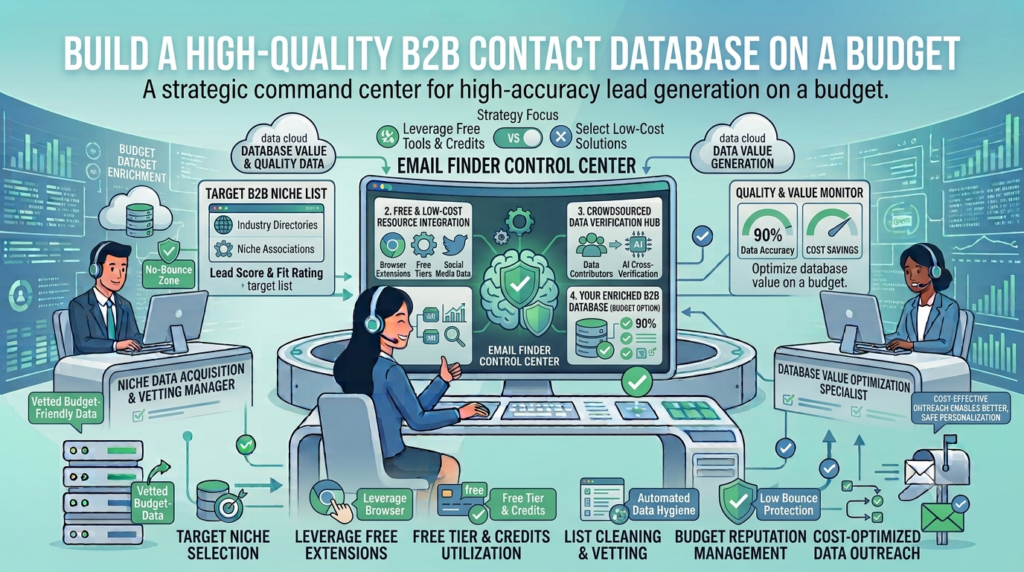
Build a High-Quality B2B Contact Database on a Budget by combining affordable tools, verified data sources, and a disciplined process instead of relying on expensive contact databases.
Building a high-quality B2B contact database on a budget isn’t about choosing between quality and cost. It’s about being strategic with where you spend money and where you invest your time.
Gartner has estimated that poor data quality costs organisations millions of pounds each year, while other studies suggest employees spend a significant portion of their time validating, correcting, and searching for accurate contact information.
Meanwhile, bootstrapped startups and small agencies are proving that Build a High-Quality B2B Contact Database on a Budget is more than possible. They achieve better results by following three core principles: targeted sourcing instead of mass data dumps, continuous verification rather than one-time purchases, and systematic data enrichment instead of paying premium prices for pre-enriched databases.
Here’s the truth many data vendors don’t advertise: the most expensive B2B databases aren’t manually verifying every email address and phone number. In many cases, they rely on the same automated verification technologies that are available to everyone, then charge a premium for convenience, packaging, and scale rather than dramatically better accuracy.
This guide explains Build a High-Quality B2B Contact Database on a Budget using proven strategies that prioritise data quality without overspending. You’ll learn how to source, verify, enrich, and maintain your contacts while keeping costs under control.
By following the methods in Build a High-Quality B2B Contact Database on a Budget, you can create a database that rivals enterprise solutions for a fraction of the price. The trade-off isn’t accuracy—it’s consistency, discipline, and a well-designed workflow.
Whether you’re a startup, agency, or growing sales team, learning how to Build a High-Quality B2B Contact Database on a Budget will help you improve outreach, reduce wasted spend, and generate better sales opportunities over the long term.
Understanding What Makes B2B Contact Data Actually Valuable
Accuracy Beats Volume Every Time
The biggest mistake in b2b database building is prioritizing quantity over quality. Recent analyses suggest B2B contact data decays at roughly 2–3% per month—compounding to around 22–30% annually for the typical database, and significantly higher in some fast-moving sectors.
Your goal isn’t the biggest database. It’s the most accurate database for your specific ideal customer profile. A verified list of 500 decision-makers who actually match your criteria will outperform 50,000 random contacts every single time.
Multiple data-quality studies have found that every dollar invested in data quality early in the process can save many times that amount in downstream remediation and lost-opportunity costs.
The Three Pillars of Quality B2B Contact Data
First, verification status. You need to know that emails are deliverable and phone numbers are active before you ever reach out. Sending emails to invalid addresses destroys your sender reputation, which affects every email you send afterward, not just the bad ones.
Second, recency. When was this contact information last verified? B2B data has a shelf life. People change jobs, companies restructure, and contact details change. A phone number that was valid six months ago might connect you to someone completely different today.
Third, context. A name and email address are data. Knowing that this person just got promoted, recently posted about a specific pain point on LinkedIn, or works at a company that just raised funding? That’s intelligence. The difference determines whether your outreach gets ignored or starts conversations.
Step 1: Define Your Ideal Customer Profile (For Real This Time)
Stop Being Vague About Who You’re Targeting
Most people skip this step or rush through it with generic descriptions like “B2B SaaS companies” or “marketing managers.” That’s not an ideal customer profile. That’s a guess with delusions of strategy.
Get specific about company attributes: industry, revenue range, employee count, technology stack, funding stage, and growth trajectory. Then get equally specific about individual attributes: job title, seniority level, department, likely pain points, and buying authority.
The narrower your focus, the cheaper your database becomes. You’re not buying access to millions of contacts. You’re identifying the few thousand that actually matter to your business.
The ICP Reality Check
Write down your ICP criteria, then ask yourself: would I cold call every single person who matches this profile? If the answer is no, your criteria aren’t tight enough. The point of a well-defined ICP isn’t to capture everyone who might possibly be interested. It’s to focus exclusively on people who are highly likely to convert.
Research from ABM and ICP studies shows that companies with tightly defined ideal customer profiles tend to report significantly higher win rates and better retention than those with broad, unfocused targeting. The counterintuitive insight? Excluding people improves results.
Step 2: Choose Your Data Sources Strategically
Free and Low-Cost Sources That Actually Work
LinkedIn remains the most valuable free source of b2b contact data, but you need to use it strategically. Sales Navigator ($99/month) pays for itself immediately if you’re building lists manually. The advanced filters let you identify decision-makers with precision that generic searches can’t match.
GitHub for technical roles, AngelList for startup contacts, and Crunchbase for company intelligence all offer free tiers that provide enormous value if you know what you’re looking for. The limitation isn’t data availability. It’s knowing which signals matter.
Industry association directories, conference attendee lists, and trade publication contributor lists often provide contact information that’s more current than what you’ll find in commercial databases. These sources are updated because people want to be found, which means the data quality is inherently higher.
When to Pay for Data (and When Not To)
Commercial b2b database providers make sense in exactly one scenario: when you need scale immediately and have a budget to burn on inevitable waste. If you’re targeting 50+ different customer segments and need 100,000 contacts yesterday, pay up.
For everyone else, the math doesn’t work. ZoomInfo often sells contracts in the tens of thousands of dollars per year, depending on seats and modules, and Apollo’s higher-tier plans can run into the high two- or low three-figure range per user each month—well beyond what most small teams need.
The sweet spot? Use free sources for identification, then pay only for verification and enrichment of the contacts you’ve already validated as fitting your ICP. You’re paying to enhance quality, not buying hope that some percentage of a massive list might be relevant.
Step 3: Manual Collection Done Right
The LinkedIn Scraping Reality
Let’s address the elephant in the room: LinkedIn’s terms of service prohibit automated scraping. Plenty of tools do it anyway, and plenty of people use those tools without consequence. That’s a risk decision you need to make for yourself.
The safer approach: manual export using LinkedIn’s native features. You can extract contact details from your connections, save searches in Sales Navigator, and export lists in ways that don’t violate ToS. It’s slower, but it’s defensible.
If you choose to use automation tools, understand that you’re betting LinkedIn won’t flag your account. Sometimes that bet pays off. Sometimes you lose access to your entire network. Choose accordingly.
Building from Inbound Signals
The highest-quality b2b contact data comes from people who signal interest first. Website visitors, content downloaders, webinar attendees, and trial signups represent contacts who’ve already raised their hands. These aren’t cold prospects. They’re warm leads with verifiable contact information.
Tools like Clearbit Reveal ($999/month) or Albacross (starts at $199/month) identify companies visiting your website. Free alternatives like HubSpot’s basic CRM or Google Analytics 4 provide company-level data that you can manually research and build into your database.
Analyses across multiple B2B sources consistently show that inbound-sourced contacts convert at materially higher rates than cold outbound lists, since those prospects have already signaled interest. Start with the people already interested in what you’re selling.
Step 4: Verification Without Breaking the Bank
Email Verification Economics
Commercial email verification services charge $0.001-0.005 per verification. That sounds cheap until you’re verifying 100,000 emails. Then it’s $100-500 just to learn which contacts are real.
The budget approach: verify in stages. Use free bulk verification tools like NeverBounce’s free tier (1,000 verifications) or Hunter.io’s free plan (50 monthly verifications) for initial screening. Pay for verification only on contacts that pass preliminary filters and match your ICP closely.
Better yet, implement what’s called “just-in-time verification.” Don’t verify your entire b2b database upfront. Verify contacts immediately before outreach. This ensures you’re checking against current data, not verifying emails that might decay before you use them.
Phone Number Validation
Phone verification is trickier and more expensive than email. Services like Numverify or Twilio Lookup charge per verification, typically $0.005-0.01 per number.
The workaround: prioritize email validation, then use phone numbers opportunistically. If someone doesn’t respond to email, that’s when you verify and try phone. You’re paying for verification only on contacts who’ve already failed to convert through cheaper channels.
For high-value accounts, verify everything upfront. For volume plays, verify progressively as you move prospects through your outreach sequence.
Step 5: Enrichment on Demand
What to Enrich and When
Data enrichment is the process of appending additional information to basic contact records: company revenue, technology stack, employee count, social profiles, job history, and more. It’s valuable, but it’s also expensive when done at scale.
The budget strategy: enrich manually for accounts that show engagement. If someone opens three emails or visits your pricing page, that’s when you spend ten minutes researching them on LinkedIn, their company website, and Crunchbase. You’re investing time in prospects who’ve demonstrated interest, not enriching thousands of contacts who might never engage.
Use free tools like Clearbit Connect (browser extension) or RocketReach’s free tier to enrich individual records as needed. Save the paid enrichment subscriptions until you’re working on volumes where manual research becomes impossible.
Building Your Own Enrichment Process
Create a standard enrichment checklist: LinkedIn profile, recent company news, technology stack (from BuiltWith or Wappalyzer), funding history, and recent social media activity. Train your team to spend 5-7 minutes gathering this intelligence on hot prospects.
This approach won’t scale to thousands of contacts. That’s the point. You’re building a b2b database optimized for quality conversations, not volume spam. TOPO (now part of Gartner) has long argued that sales teams who research and personalize outreach upfront see significantly higher connect and response rates than teams that rely on generic templates.
Why Per-Lead Pricing Doesn’t Work for Database Building
Here’s the fundamental problem with traditional b2b database providers: they charge per lead or per credit, which creates perverse incentives. You’re financially penalized for exploring different segments, testing new ICPs, or enriching contacts you’ve already identified. Every export costs money, so you’re incentivized to download massive lists and hope something sticks.
This pricing model made sense when data was scarce. In 2025, data abundance is the problem, not scarcity. You don’t need access to 500 million contacts. You need efficient ways to find the 5,000 that matter and the freedom to experiment without watching a meter run.
SmartProspect flips this model entirely. At $59/month flat rate, you get access to verified B2B contact data with unlimited searches and exports. No credits, no per-lead charges, no anxiety about whether this search will burn through your monthly allowance.
How Flat-Fee Pricing Changes Your Database Strategy
When you’re not paying per contact, your entire approach to database building changes. You can test multiple ICP variations to see what converts best. You can build separate databases for different campaigns without worrying about duplicate charges. You can re-export lists quarterly to catch job changes and updated contact information.
This matters more than it sounds. Advisory firms like SiriusDecisions have highlighted that teams often need to test multiple audience segments before honing in on their best-performing ICP.
Under per-lead pricing, that kind of experimentation quickly becomes expensive; with flat-fee access, the cost of testing is mostly your time. With flat-fee access, it costs nothing but time.
Step 6: Maintaining Database Health
The Decay Problem
B2B contact data degrades relentlessly. People change jobs, companies reorganize, email addresses get deactivated, and phone numbers get reassigned. Multiple studies estimate that around 20–30% of B2B contact data becomes inaccurate over the course of a year, and in some industries, the rate can be even higher.
You can’t prevent decay. You can only manage it systematically. Implement quarterly re-verification of your entire database, focusing first on your most valuable segments. Flag contacts with bounced emails or disconnected phone numbers immediately, then research updated information for high-value accounts.
Use engagement as a proxy for accuracy. Contacts who open emails, click links, or visit your website are probably still valid. Contacts with zero engagement for 12+ months? Assume they’re outdated until proven otherwise.
Systematic Update Protocols
Build contact database maintenance into your weekly routine, not something you do when you finally admit the data is unusable. Every Monday, someone on your team should process bounces from the previous week, flag outdated contacts, and update records based on reply intelligence.
When prospects reply with “I’m no longer in that role,” don’t just remove them. Ask for the new decision-maker’s contact. When emails bounce, check LinkedIn to see if the person changed companies. Every decay event is an opportunity to update your database with current information.
Step 7: Organizing for Actionability
Segmentation That Actually Matters
A b2b database without structure is just a pile of contact information. The value comes from organizing contacts in ways that inform action: by industry, by engagement level, by account priority, by sales stage, by last contact date.
Create segments based on how you’ll actually use the data. “Decision-makers at Series A SaaS companies who visited our pricing page” is a segment that tells you exactly what to do. “Marketing managers” is a category that provides no strategic direction.
Use tagging systems that compound. Instead of creating mutually exclusive categories, use multiple tags per contact: industry tags, seniority tags, engagement tags, and intent signal tags. This lets you create highly specific segments by combining filters.
CRM Integration from Day One
Don’t build your b2b contact database in spreadsheets with plans to migrate later. Start with a CRM, even if it’s HubSpot’s free tier or a simple Airtable base. The structure and automated workflows of a proper CRM make maintenance exponentially easier than managing flat files.
Your CRM should automatically flag records without activity, track engagement history, and surface contacts who match specific criteria. If you’re manually searching for which prospects to contact next, you’ve already lost the efficiency game.
The Tools That Make Budget Database Building Possible
Essential Free and Freemium Tools
Hunter.io’s free tier provides 50 email searches per month and basic verification. LinkedIn Sales Navigator gives you granular targeting for $99 monthly, far cheaper than commercial data purchases. Google Sheets with proper formulas can automate significant portions of data cleaning and deduplication.
Apollo.io’s free tier offers 10,000 email credits and 120 mobile credits annually, which is enough for targeted outbound if you’re selective. Snov.io provides 50 credits monthly on their free plan. These aren’t enough for scale operations, but they’re perfect for bootstrapped database building.
Clearbit Connect (browser extension) offers free enrichment for individual lookups. Norbert or RocketReach’s free tiers do the same. You won’t enrich thousands of records, but you’ll get what you need for high-priority accounts.
When to Graduate to Paid Tools
Once you’re managing 10,000+ verified contacts and your team is spending more than 10 hours weekly on manual processes, that’s when paid tools justify their cost. Not before.
The transition from free tools to paid infrastructure typically happens around the 5,000-10,000 contact mark. At that scale, the time cost of manual processes exceeds the subscription cost of automated solutions.
The question isn’t whether paid tools are better. They are. The question is whether the marginal improvement justifies the cost at your current scale. For most small teams, the answer is no until you’ve maximized what free and low-cost tools can deliver.
Common Mistakes That Waste Money and Time
Buying Data Before Defining Process
The most expensive mistake is buying access to a commercial b2b database before you’ve built systems to maintain and action that data. You’ll spend thousands on data access, use 5% of it, let the rest decay, then complain that the data quality was poor.
Data is only as valuable as your ability to use it systematically. Build your outreach process first, test it with manually collected contacts, then scale data acquisition once you know what works.
Ignoring Compliance and Regulations
GDPR, CCPA, CAN-SPAM, and various industry-specific regulations govern how you can collect, store, and use b2b contact data. Violating these doesn’t just risk fines. It destroys your sender reputation and can get your entire infrastructure blacklisted.
Don’t buy lists from sketchy vendors. Don’t scrape data from sources without considering legal implications. Don’t email people without a legitimate interest or prior relationship. The short-term gain isn’t worth the long-term consequences.
Forgetting That People Change Jobs
The average B2B decision-maker changes jobs every 3-5 years. Your meticulously built database becomes partially obsolete simply through career progression. Yet most teams treat their b2b contact database as static assets rather than living resources that require constant attention.
Include job change monitoring in your process. Tools like LinkedIn alerts or manual quarterly reviews help you catch when key contacts move. Often, these job changes create new opportunities as your contacts bring their pain points and awareness of your solution to new companies.